The global economy is undergoing a period of profound transformation. Geopolitical tensions, trade policy uncertainty, supply chain disruptions, and growing concerns over strategic dependencies are prompting multinational enterprises (MNEs) to reassess how and where they produce and create value. Yet despite these challenges, Global Value Chains (GVCs) remain a fundamental pillar of the world economy. According to the OECD, trade and the activities of foreign affiliates continue to account for approximately 45 per cent of global GDP, underlining the enduring importance of international production networks (OECD, 2026).
The question for MNEs is therefore not whether international production will continue but how to balance the competitiveness and resilience of tomorrow’s supply chains.
Accordingly, recent data suggests that today’s value chains are already evolving and adapting. In 2025, trade between geographically closer economies expanded slightly faster than trade between more distant economies, marking a departure from the long-term trend toward increasingly dispersed production networks. Whether this represents a structural shift remains uncertain. Much will depend on trade policy and geopolitical uncertainties, and, above all, on the strategies that MNEs adopt to manage risk in an increasingly volatile international environment (UN Conference on Trade and Development, 2025).
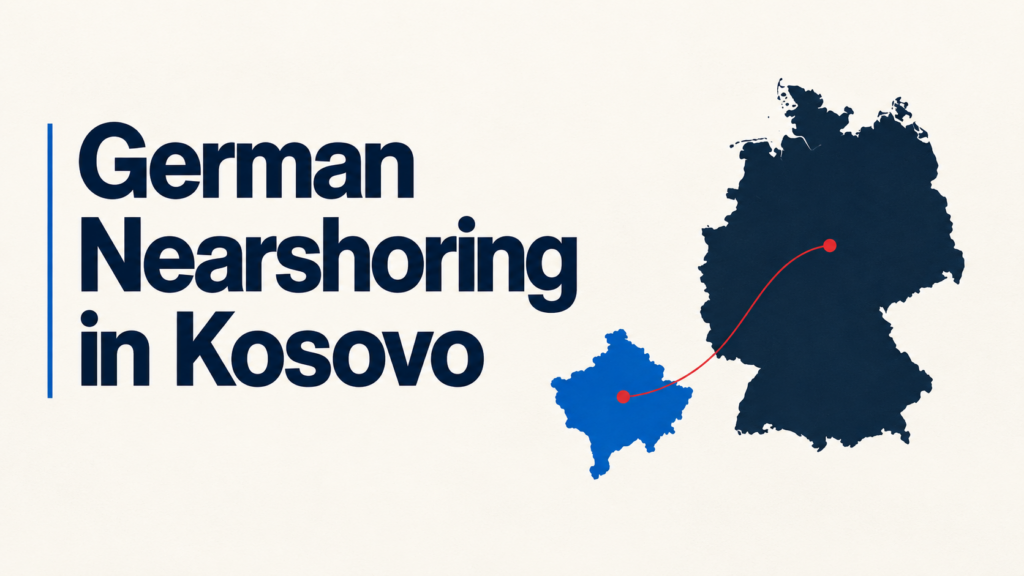
Nearshoring has emerged as a strategic response for companies seeking to combine efficiency and resilience. Considering increased pressure on German MNEs, this paper explores Kosovo’s current and potential role in German manufacturing supply chains.
The Economic Trade-Off Behind Nearshoring
The decision to nearshore is ultimately an economic trade-off. Speaking at the Conference on European Economic Integration in 2021 about global value chain prospects for the Central, Eastern and Southeastern European region, Giorgio Barba Navaretti argued that firms choose nearby production locations when the costs and risks associated with distant locations exceed the disadvantages of operating closer to final markets (Navaretti, 2021).
Since then, the economic logic of nearshoring has remained the same, but the calculus has shifted. Costs associated with long and complex supply chains have increased considerably, while many of the perceived disadvantages of operating in nearby emerging locations have diminished. As a result, companies are increasingly evaluating alternative production locations that combine competitiveness with greater resilience.
The Rising Cost of Distance
One of the most visible consequences of recent disruptions has been rising trade-related costs. International shipping costs are extremely high, with Drewry’s World Container Index reporting a reading of USD 4,465 per 40-foot container in 2026, representing a year-on-year increase of 112 per cent and approaching the levels observed during the pandemic-era supply chain crisis (Drewry Shipping Consultants Limited, 2026).
Although less dramatic, cost pressures are not limited to shipping. Labour costs in the transportation and storage sector of the euro area have increased by approximately 18 per cent since 2021, adding further pressure on internationally fragmented supply chains (European Central Bank | Eurosystem, 2026).
Beyond logistics, geopolitical uncertainty increasingly adds costs along the value chain. The latest Global Financial Stability Report of the International Monetary Fund finds that investors systematically price geopolitical risks into financial markets, contributing to higher sovereign and investment risk premiums (International Monetary Fund, 2025). At the same time, demand for insurance against political risks, trade disruptions, and supply chain interruptions has grown as firms seek protection from an increasingly fragmented global environment (Schanz, 2025).
The economic cost of distance has increased. Reducing excessive fragmentation can therefore lower not only risk, but also the indirect costs generated by that risk in logistics, financing, insurance, and coordination. Accordingly, nearshoring allows firms to reduce both direct and indirect costs associated with risk whilst still preserving the benefits of international economic integration.
Kosovo’s Growing Appeal as a Nearshoring Destination
For German companies seeking nearby production locations, Kosovo is becoming an increasingly attractive option. Geographic proximity to European markets, established economic links with Germany, and improving domestic business conditions strengthen Kosovo’s position within emerging regional value chains.
The country’s investment performance illustrates this trend and suggests growing investor confidence despite a challenging global environment. Kosovo consistently records one of the highest foreign direct investment (FDI) shares of GDP among the six Western Balkan economies. In 2025, Kosovo further increased its FDI share, while almost all the Western Balkans, on average, experienced a decline in FDI inflows (World Bank, 2026).
Further, the underutilization of human capital is identified both as a constraint and a considerable opportunity in the region (World Bank, 2026). As such, Kosovo possesses a young and increasingly educated workforce with a significant share in unemployment (Kosovo Agency of Statistics, 2024). Longstanding migration links have fostered familiarity with the German language, culture, and business practices (Auswärtiges Amt, 2026), giving German companies, facing domestic skills shortages (Burstedde, 2026), a competitive advantage to access this underutilised talent pool.
Institutional improvements and EU alignment further support Kosovo’s attractiveness as an investment destination. The EU-Kosovo Stabilisation and Association Agreement, Kosovo’s application for EU-membership and visa free travel into the EU by Kosovar citizens mark important milestones in Kosovo’s way into the EU (European Commission, 2025). Further, since 2021, Kosovar governance indicators have improved across nearly all dimensions measured by the World Bank. Particularly notable progress has been recorded in the areas of rule of law, regulatory quality, and control of corruption, strengthening the country’s overall business environment (World Bank Group, 2025).
Germany and Kosovo: A Strong Link in the Global Value Chain
Kosovo’s growing importance as a nearshoring and supply chain location for German companies reflects a broader global trend in which non-OECD economies are becoming increasingly important destinations for investment from OECD-based MNEs (OECD, 2026). Kosovo’s integration into German value chains is already becoming evident at the company level: BIZMARK supplies German manufacturers with processed metal inputs, while MUNDA is embedded in the German automotive supply chain through its production of specialised textile components.
Kosovo’s manufacturing sector has demonstrated sustained growth and diversification over the last decade. Manufacturing value added has expanded at an average annual rate of 4.6 % (World Bank Group | Data, 2025). But this development is not solely driven by domestic demand: exports have also grown substantially. Compared with its pre-pandemic level in 2019, Kosovo’s export value had more than doubled by 2024, reaching EUR 941.5 million (Kosovo Agency of Statistics, 2025). Beyond growth in export volumes, Kosovo’s export structure is becoming increasingly diversified. A growing number of exported products points to a gradual process of industrial upgrading and specialization within the country’s manufacturing sector (Secretariat of the National Council for Economy and Investments, 2025).
Germany has played a vital role in driving these developments, as Kosovo’s largest investor (Central Bank of the Republic of Kosovo, 2026) and trading partner1 (Kosovo Agency of Statistics, 2025). German investment is visible in metal processing, wood processing and furniture production as well as energy efficiency (Wittmann, 2026), and these patterns are increasingly reflected in Kosovo’s exports to Germany.
While plastic products remain an important export category, some of the fastest export growth is occurring in sectors associated with German investment activity. Exports of furniture and related products, including beds and mattresses, increased by approximately 40 per cent in 2024, while exports of structures and parts of structures made from iron, steel, or aluminium grew by around 60 per cent year-on-year (Kosovo Agency of Statistics, 2025).
The growing degree of bilateral economic integration is equally apparent in overall trade figures. Over the last decade, the value of German imports from Kosovo grew by a staggering average annual rate of 27.5 %2, to EUR 114 million in 2025 (Statistisches Bundesamt, 2026).
Outlook
Global Value Chains are unlikely to disappear. Rather, they are adapting to a business environment characterized by greater uncertainty, higher transport costs, and increased geopolitical risk. As this environment is priced into value chains, resilience and efficiency are no longer opposites.
In this context, Kosovo’s position as a nearshoring destination is becoming increasingly relevant, especially for German MNEs. A young workforce, improving governance standards and expanding manufacturing capabilities provide a credible foundation for deeper integration into European value chains.
Whilst Kosovo can’t be seen as a one-to-one replacement for established production locations in Asia or Central Europe, recent global and domestic developments open a window of opportunity for Kosovo to become a complementary location within a more diversified and resilient European production architecture. For German companies, the practical next step would be to assess suppliers, partners and investment opportunities. Ideally through direct market visits and business-to-business meetings.
Bibliography
Auswärtiges Amt, 2026. Deutschland und Kosovo: Bilaterale Beziehungen. [Online] Available at: https://www.auswaertiges-amt.de/de/service/laender/kosovo-node/bilateral-207462 [Accessed 7 September 2026 ].
Burstedde, A., 2026. 2026, IW-Arbeitsmarktfortschreibung 2029: Beschäftigungspotenziale sinken, IW-Kurzbericht, Nr. 61, , Köln: Institut der Deutschen Wirtschaft.
Central Bank of the Republic of Kosovo, 2026. Annual Report 2025, Prishtina: Central Bank of the Republic of Kosovo.
Drewry Shipping Consultants Limited, 2026. Drewry – World Container Index. [Online] Available at: https://www.drewry.co.uk/supply-chain-advisors/supply-chain-expertise/world-container-index-assessed-by-drewry [Accessed 04 September 2026].
European Central Bank | Eurosystem, 2026. ECB Data Portal: Labor cost index – total labor costs, Euro area 20, Quarterly: Transportation and Storage. [Online] Available at: https://data.ecb.europa.eu/data/datasets/LCI/LCI.Q.I9.Y.LCI_T.H [Accessed 7 September 2026].
European Commission, 2025. Kosovo* 2025 Report – 2025 Communication on EU Enlargement Policy. Brussels , European Commission.
International Monetary Fund, 2025. Global Financial Stability Report – Enhancing Resilience amid Uncertainty, Washington: International Monetary Fund, Publication Services.
Kosovo Agency of Statistics, 2024. Unemployment and unemployment rate, by sex and age group, 2012 – 2024. [Online] Available at: https://askdata.rks-gov.net/pxweb/en/ASKdata/ASKdata__Labour%20market__Anketa%20e%20Fuqis%c3%ab%20Pun%c3%abtore__Annual%20labour%20market/tab19.px/table/tableViewLayout1/ [Accessed 21 September 2026].
Kosovo Agency of Statistics, 2025. Kosovo International Trade Statistics, 2024 , Prishtina: Kosovo Agency of Statistics.
Navaretti, G. B., 2021. RESILIENCE AND SHORTENING OF GVCs. Vienna, Conference on European Economic Integration.
OECD, 2026. Trends in Global Value Chains, Paris: OECD Publishing.
Schanz, K.-U., 2025. Insurance in a Fragmented World Economy , Zurich: Geneva Association.
Secretariat of the National Council for Economy and Investments, 2025. Kosovo Economy at a Glance, Pristina: National Council for Economy and Investments.
Statistisches Bundesamt, 2026. Aus- und Einfuhr (Außenhandel): Deutschland, Jahre, Länder – Kosovo (ab 06/2005). [Online] Available at: https://genesis.destatis.de/datenbank/online/statistic/51000/table/51000-0003/chart/line#chartFilter=JTdCJTIyZGlhZ3JhbVR5cGUlMjIlM0ElMjJsaW5lJTIyJTJDJTIyY29udGVudCUyMiUzQSUyMldFUlRFJTI0Q0gwMDA4JTIyJTJDJTIyeEF4aXNWYXJpYWJsZXMlMjIlM0ElNUIlMjJKQUhSJTIyJTVEJT [Accessed 1 September 2026].
UN Conference on Trade and Development, 2025. Key Statistics and Trends in International Trade – Geoeconomic forces influence the dynamics of international trade, New York : United Nations Publications.
Wittmann, H.-J., 2026. Germany Trade and Invest – Wirtschaftsausblick Kosovo: Kosovos Wirtschaft wächst trotz zahlreicher Herausforderungen. [Online] Available at: https://www.gtai.de/de/trade/kosovo-wirtschaft/wirtschaftsausblick [Accessed 1 September 2026].
World Bank Group | Data, 2025. Manufacturing, value added (annual % growth) – Kosovo. [Online] Available at: https://data.worldbank.org/indicator/NV.IND.MANF.KD.ZG?locations=XK [Accessed 1 September 2026].
World Bank Group, 2025. World Wide Governance Indicators – Interactive Data Access: Kosovo. [Online] Available at: https://www.worldbank.org/en/publication/worldwide-governance-indicators/interactive-data-access [Accessed 1 September 2026].
World Bank, 2026. Western Balkans Regular Economic Report No. 29 Spring , Washington: World Bank.
Author:
Vincent Welte