Kosovo’s ICT sector has emerged as one of the country’s fastest-growing industries and an increasingly attractive destination for international partnerships. Driven by a young, multilingual workforce, an export-oriented business model, and growing experience in serving European and North American clients, Kosovo offers German companies a compelling environment for nearshoring, software development, and long-term innovation partnerships.
According to the Kosovo IT Barometer 2023–20241, Kosovo’s ICT sector continues to demonstrate strong international orientation and resilience despite its relatively young age. Most companies have been established within the last decade, reflecting a dynamic entrepreneurial environment that is quick to adopt new technologies and respond to changing international market demands.
Today, Kosovar ICT companies provide services ranging from software and web development to custom digital solutions, IT consulting and support, UI/UX design, digital marketing and increasingly, AI-enabled applications. A significant share of companies already serves international clients across Europe and North America, with the DACH region emerging as one of the sector’s most important export markets. This growing presence in German-speaking markets reflects not only demand for Kosovar expertise, but also increasing familiarity with German business practices, quality requirements and client expectations
A Natural Partner for German Companies
For German technology companies, Kosovo offers several advantages that go beyond cost competitiveness.
The country’s young and adaptable workforce provides access to a growing pool of software developers, engineers and other digital professionals. English is widely spoken within the sector, while German language capabilities are also developing. Kosovo’s location in the Central European time zone allows teams to work within the same or closely aligned working hours as their German counterparts, making day-to-day cooperation significantly easier.
Kosovo’s ICT sector has also developed with an international outlook from the beginning. With a relatively small domestic market, many companies have built their business models around international clients. As a result, they are accustomed to working across borders, adapting to different client requirements and integrating into international project teams.
Cost competitiveness remains another important factor. Operating and labour costs are far lower than in Germany, while the sector is increasingly investing in modern technologies, professional development and international standards. For German companies, this can provide an opportunity to expand development capacity, access specialized talent and increase flexibility without moving core operations away from Germany.
At a time when European companies are reassessing their technology supply chains, they often have to weigh of between cost and resilience advantages. Kosovo combines both and offers a unique combination of talent, proximity, flexibility and cost efficiency.
From outsourcing to strategic partnerships
The opportunity is increasingly moving beyond traditional outsourcing.
Kosovar companies are developing capabilities in areas such as artificial intelligence, cloud technologies, cybersecurity, software engineering and digital transformation. This creates potential for German companies to establish dedicated development teams, outsource selected functions, develop products jointly or build longer-term technology partnerships.
There are already examples of German companies establishing operations or development capacities in Kosovo, while Kosovar technology companies are expanding their presence in Germany.
Several German–Kosovar ICT success stories demonstrate the potential for further cooperation and investment in the sector. Borek Solutions Group has established operations in Kosovo, drawing on the country’s growing pool of ICT professionals and Celonis has gone even one step further by establishing a Development Center of Excellence in Pristina.
“Kosovo has provided a very suitable environment for Celonis to evolve our product and organization by establishing a world-class, talented, productive and efficient team that has been able to contribute to the Celonis Platform and support our enterprise customers.”
Bardh Lohaj, Engineering Lead at Celonis
At the same time, Kosovar technology companies are increasingly expanding into the German market. NOVUS– an IT consultancy – which has sucessfully built an international client base out of Kosovo, recently opened an office in Munich to strengthen its presence in Germany.
“For several years, NOVUS has been successfully serving clients in the German market, particularly in cybersecurity, compliance, and digital transformation. Our expansion into Germany represents a natural next step in our growth and reflects the capabilities, expertise, and international competitiveness that companies from Kosovo can bring to one of Europe’s most demanding markets.
Kosovo has a young, highly skilled, and internationally oriented technology workforce, while Germany offers a mature market with a growing demand for trusted technology and cybersecurity expertise. At NOVUS, we are committed to strengthening this bridge and further expanding our long-term presence in Germany.”
Leonora Mehmetaj, CEO & Partner at Novus
These developments demonstrate a strong and receiprocal cooperation.Kosovo no longer serves solely as a service provider, but increasingly establishes itself as part of a broader European technology and innovation network.
A Growing Ecosystem
The relatively young age of Kosovo’s ICT sector is also an opportunity. The ecosystem is still developing, leaving considerable room for new investors, technology companies and strategic partners to shape its next phase of growth.
Investment opportunities extend beyond individual companies. There is potential for German companies to establish development centres, build specialised teams, partner with local technology firms, support start-ups and invest in skills development. Cooperation with universities and other education providers can further strengthen the talent pipeline and create programms tailored to industry needs.
Germany’s experience with dual education, applied training and strong cooperation between companies and educational institutions is particularly relevant in this context. Greater cooperation in these areas could help address the growing demand for specialised digital skills while creating a stronger basis for long-term investment.
For German companies, this means that entering Kosovo does not necessarily have to be limited to a conventional client–supplier relationship. There is an opportunity to become part of the development of the ecosystem itself.
Looking Ahead
European companies are increasingly looking for technology partnerships that offer resilience, proximity and access to skilled talent. At the same time, demand for digital solutions, AI expertise and software development continues to grow across almost every sector of the economy.
Kosovo is well positioned to benefit from these trends. Its proximity to Germany, growing DACH market orientation and expanding technology ecosystem provide a strong foundation for deeper economic cooperation.
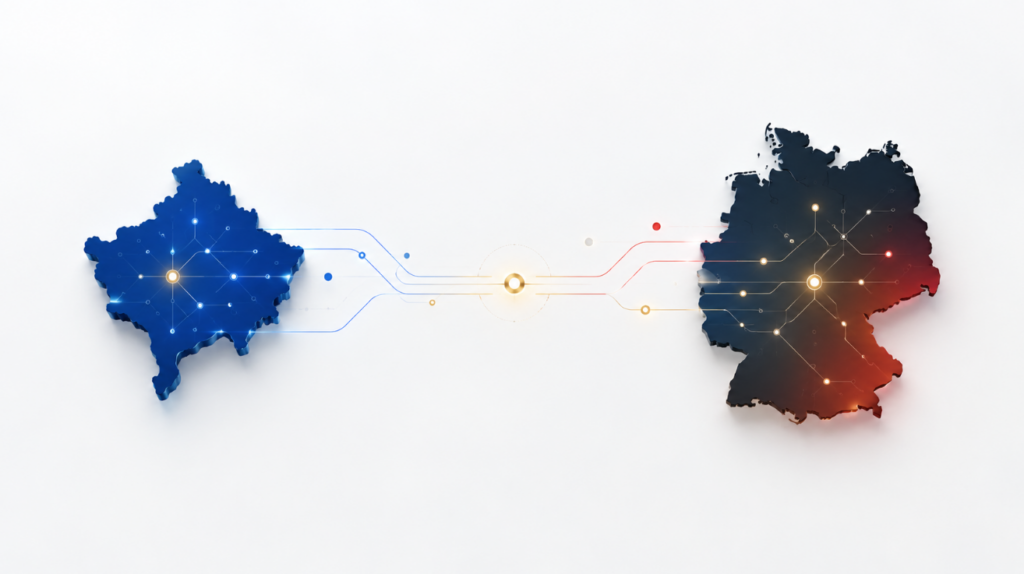
For German companies, the opportunity is to combine the strengths of two markets: Germany’s industrial expertise, capital and established customer base with Kosovo’s young talent, entrepreneurial companies and growing digital capabilities.
The next phase of German–Kosovar technology cooperation should therefore go beyond traditional nearshoring. The greater opportunity lies in building long-term partnerships, joint development capacities and new technology solutions for the European market.
German technology companies, investors and innovation partners are invited to explore Kosovo’s ICT ecosystem, meet local companies and talent, and assess opportunities for establishing or expanding their presence in one of Southeast Europe’s fastest-developing digital markets.
Authors:
Vincent Welte
Rreze Gashi